

Move-Out Cleaning in Fairfax, VA: Cost vs. Your Deposit
- Move-out clean is an inspection-grade reset: the standard is to show no evidence of the last tenant, not just appear tidy.
- Concentrate on inside the oven, fridge gaskets, window tracks, baseboards, cabinets, and tub/shower grout.
- DIY costs time, supplies, and fatigue; professional pricing depends on size, condition, and add-ons, typically 1.5 to 2 times a deep clean.
- Virginia Residential Landlord and Tenant Act requires an itemized statement; photograph each room and keep a dated, itemized cleaning invoice to contest deductions.
- Hire a professional if lease requires a receipt, you have pets, multiple bathrooms, a large deposit, or you move in peak season.
If you are handing back the keys to a rental in Fairfax, you are weighing one very specific question: is it cheaper to clean the place yourself, or to pay for a professional move-in/move-out cleaning and protect the deposit? It is a fair question, and it deserves a straight answer rather than a sales pitch.
At Virginia Housekeepers, move-out work is one of the most common jobs we take on across Fairfax County — and we have seen both outcomes. We have seen tenants save several hundred dollars by spending a Saturday with a bucket and a checklist. We have also seen tenants lose most of a four-figure deposit over an oven, a range hood, and a set of window tracks. Below is how to tell which situation you are in.
What move-out cleaning in Fairfax, VA actually has to accomplish
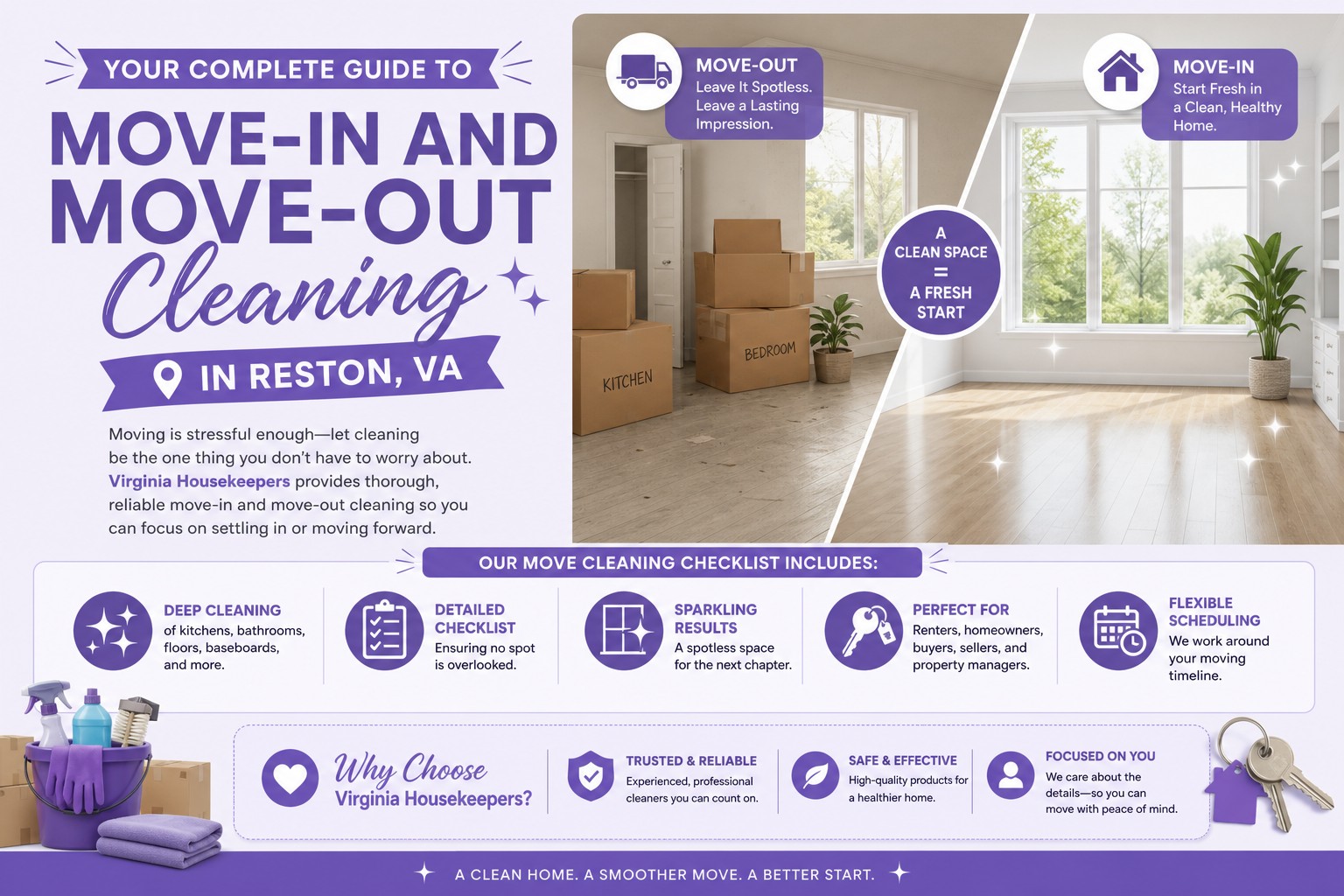
A move-out clean is not a tidy-up. It is an inspection-grade reset of an empty home, measured against a walkthrough checklist that a property manager will run with a flashlight. The standard is not “looks clean.” The standard is “shows no evidence of the last tenant.”
In practice, that means the work is concentrated in places that normal weekly cleaning never touches:
- Inside the oven, broiler drawer, and range hood filter. Baked-on carbon is the single most commonly deducted item we see. A degreaser needs 20–30 minutes of genuine dwell time on the enamel before anything comes off; scrubbing early just polishes the grease around.
- Inside the refrigerator, including the crisper rails and door gaskets. Gaskets hold mold in the folds. They need to be pulled open and wiped individually.
- Window tracks, sills, and sliding-door channels. Northern Virginia’s spring pollen and summer construction dust turn these into a grey paste. Vacuum first, then wet-clean — do it in the other order and you make mud.
- Baseboards, door frames, and switch plates. Nothing signals “not professionally cleaned” faster than clean floors under dusty baseboards.
- Inside all cabinets, drawers, and closets, including the top shelf nobody can see without a step stool.
- Light fixtures and ceiling fan blades, which in a two-story Fairfax colonial usually means a ladder and a second person.
- Tub, shower, and grout, where hard water scale in much of Fairfax County leaves a chalky film that ordinary bathroom spray will not dissolve. That film is mineral, not soap, and needs an acidic cleaner (a phosphoric or citric-acid product) rather than more bleach.
The honest cost comparison
Here is the part most cleaning-company blogs skip. A DIY move-out clean is not free — it costs time and supplies — and a professional clean is not automatically worth it. Compare the two like this.
What DIY really costs you
For an empty two-bedroom apartment or condo in Fairfax, a thorough move-out clean done properly by one person is realistically 6–10 hours. A three-to-four bedroom townhome or single-family house with multiple bathrooms is a full weekend for two people, and that is on top of the physical move itself. Add oven cleaner, a degreaser, a descaler, microfiber, a good vacuum with a crevice tool, and a step ladder.
Then add the risk factor: you are doing this the same week the movers, the utility transfers, and the new lease are all happening. Fatigue is when window tracks get skipped.
What a professional move-out clean costs
We do not publish a flat rate, and you should be cautious about any company that quotes a price for your home before seeing its size and condition. Move-out pricing is driven by a small number of honest variables:
- Square footage and number of bathrooms. Bathrooms and kitchens carry most of the labor; bedrooms are comparatively fast.
- Condition. A home cleaned regularly during the tenancy is a fraction of the work of one that was not. This is the biggest single swing in any move-out quote.
- Scope add-ons — interior windows, inside the refrigerator or oven if you want them separated out, garage sweeps, wall spot-cleaning, post-construction dust after a landlord repair.
- Empty vs. occupied. An empty home cleans faster and cleans better. Schedule the clean after the last box leaves.
As a rule of thumb we give people over the phone: a full move-out clean is typically in the range of 1.5 to 2 times the cost of a standard one-time deep cleaning of the same home, because of the interior-of-everything scope. If you want a real number for your address, our quote request takes a couple of minutes.
What is actually at stake: your Virginia security deposit
Virginia law is more tenant-friendly here than most people assume, and knowing the rules changes the math. Under the Virginia Residential Landlord and Tenant Act, a landlord may deduct for damages and for other charges owed under the lease, but must provide an itemized written statement of deductions, generally within 45 days of the end of the tenancy (see the Code of Virginia § 55.1-1226). You are also entitled to be present at the move-out inspection if you request it in writing.
Two practical consequences:
- Ordinary wear and tear is not chargeable. Faded paint and traffic patterns on carpet are wear. Grease on the range hood and soap scum in the shower are not — those are cleaning items, and they are exactly what gets billed back at a marked-up “make-ready” rate.
- Documentation wins disputes. Photograph every room after the clean, timestamped, before you hand over keys. If you use a professional service, keep the invoice; a dated, itemized cleaning invoice is the single most useful document in a deposit dispute.
So — when should you just do it yourself?
We would rather tell you honestly than sell you something you don’t need. Clean it yourself if most of the following are true:
- You are leaving a studio or one-bedroom, and it has been cleaned regularly.
- Your deposit is modest relative to the cost of a professional clean.
- You have two clear days after the movers leave and before the key handover.
- You are physically able to do overhead and floor-level work — fans, tracks, baseboards, tub grout.
- Your lease does not require a receipted professional cleaning (some Fairfax-area property managers do; read the lease before you decide anything else).
Hire a professional if any of these are true:
- Your lease specifically requires professional cleaning with a receipt. This is common in managed communities around Fair Lakes, Mosaic District, and the Vienna and Dunn Loring Metro corridors, and it makes the decision for you.
- The deposit at risk is large — in much of Fairfax that means a month’s rent on a home renting well above the national average.
- You had pets. Pet hair works into carpet edges, HVAC returns, and baseboard gaps, and pet odor is a frequent deduction line.
- The home has more than two bathrooms, or three or more levels of stairs.
- You are closing on a sale rather than ending a lease — buyers do a final walkthrough, and a pre-sale deep clean is a different, higher standard again.
- Your move-out and move-in dates overlap by 48 hours or less. Time, not money, is usually the real constraint.
A Fairfax-specific timing note
Fairfax County’s rental market turns over hard at the end of June, July, and August, driven by school calendars, government transfers, and university leases. Cleaning capacity in the county is genuinely tight in those weeks. If you are moving in peak season, book the clean when you book the movers, not after — a week’s notice in mid-July is a very different conversation than a week’s notice in February.
Also plan around weather. If you are moving out in spring, oak and pine pollen coats sills and tracks within a day or two of any open window, so the final clean should come after the last load and the last open door. In winter, road salt and grit tracked into entryways and stairs is the equivalent problem.
How to get the most out of a professional move-out clean
Whichever way you go, these steps make the outcome better:
- Be completely empty first. Every item left behind is a surface that can’t be cleaned under.
- Handle repairs before the clean, not after. Patching and touch-up paint creates dust that lands on everything you just paid to clean.
- Share the landlord’s checklist. If your property manager gave you a move-out standard, hand it over. We would rather work to their list than to a generic one.
- Keep utilities on. No hot water and no power means no clean. This catches people out more often than you’d think.
- Book the inspection at least a day after the clean, so there is room to fix anything flagged.
The bottom line
For a small, well-maintained apartment with a modest deposit, DIY is a reasonable call and we will say so. For a multi-level Fairfax townhome, a pet household, a lease that demands a receipt, or a deposit worth more than a weekend of your time, a professional move-out clean is straightforward risk management — you are buying a documented result, not just clean floors.
Virginia Housekeepers has served homes across Fairfax County for years, and our teams are insured, background-checked, and work from a move-out checklist built around what local property managers actually inspect. If you’d like a real number for your home, see our Fairfax, VA house cleaning and maid services page or request a quote — and if we think you’d be fine doing it yourself, we’ll tell you that too.
Share this article
Related Posts















Follow us
A quick overview of the topics covered in this article.